Sustainable Choices to Protect the Javan Rhino
Section 1
For this assignment I chose the Javan Rhinoceros. The Javan Rhinoceros look very similar to Indonesian Rhinos, but they are a little smaller than them. They are gray have loose skin on their necks and can be as long as 10.5 feet long. They can weigh up to almost 4500 pounds depending on male or female. You can also tell them apart by their horns. Males will have horns you can see, and females' horns won't protrude their skin. These rhinos eat things they can find with ease like fruit that has fallen, sticks, leaves (things that are on the ground). In order to reproduce the female has to be at least 3 or 4 but the male has to be 5 or 6. A female will have a single baby rhino every 4-5 years and the baby will stay with them for the first 2 years of its life. This species of rhinos is critically endangered and its estimated that there is around 46-66 mature Javan Rhinos left.
 This is what an Indian Rhino looks like.
Section 2
The type of habitat that the Javan Rhino lives in is the forest. Specifically, lower elevation areas in the tropical rainforest. As a result of their low numbers nobody is positive in which biome, they preferer, it's just known they are still in the rain forest.
 A cool picture inside the rainforest.
They like the rainforest because of its temperature and the diversity it provides, they can be in thicker areas where they will be hard to spot or in more open areas. Temperatures in the rainforest stay around 70 to 80 degrees but can get higher. The rainforest can also get up to 260 inches of rain a year which is 5x more than New Hampshire gets.
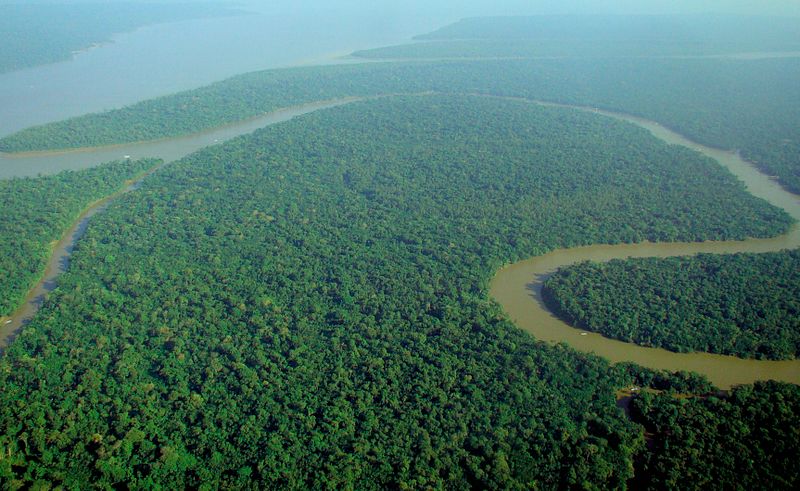 An aerial view of the rainforest(very big)
However, in the past they had been in many different habitats like high elevation grasslands but because of how rare this species is now it hard to say if they are still this diverse. For the ones that are in the rain forest you can usually find them near water sources. The females will stay closer to these water sources while the males will use a much bigger area to wander. The remaining Javan Rhinos can be found in protected areas because how dangerous it is for them to live in the wild.
The type of habitat that the Javan Rhino lives in is the forest. Specifically, lower elevation areas in the tropical rainforest. As a result of their low numbers nobody is positive in which biome, they preferer, it's just known they are still in the rain forest.
A cool picture inside the rainforest.They like the rainforest because of its temperature and the diversity it provides, they can be in thicker areas where they will be hard to spot or in more open areas. Temperatures in the rainforest stay around 70 to 80 degrees but can get higher. The rainforest can also get up to 260 inches of rain a year which is 5x more than New Hampshire gets.
An aerial view of the rainforest(very big)However, in the past they had been in many different habitats like high elevation grasslands but because of how rare this species is now it hard to say if they are still this diverse. For the ones that are in the rain forest you can usually find them near water sources. The females will stay closer to these water sources while the males will use a much bigger area to wander. The remaining Javan Rhinos can be found in protected areas because how dangerous it is for them to live in the wild.
 This is a Javan Rhino standing in a stream.
Section 3
The Javan Rhinoceros’s threats are mostly biotic. One of the biggest threats that this animal has faced throughout its time is hunting. People hunt the rhinos for their skin, bones, horns, basically for everything. The main reason is their horns, their horns are very sought after in Chinese culture because it is though that they can act as medicine. This is a huge threat and because of it they are almost extinct and there is a good chance that they will become extinct. If they had been located in a different biome, like one that would be harder for humans to gain access to or one that would be too harsh for humans to stay in for a long time people most likely wouldn’t have hunted them to the intensity that they did. A biome that could have provided that for them would be the Taiga and in some parts of the temperate forest. This threat then factored in with the issue they face in their biome which is logging it makes it very hard for them to survive because their main source of food is things that grow on the ground or things that will fall to the ground. When the loggers come in, they are removing trees that drop fruit for them and they are destroying the lower level things like small saplings that have leaves or small sticks on the ground. By the time the loggers leave what was once their home is a wasteland.
The Javan Rhinoceros’s threats are mostly biotic. One of the biggest threats that this animal has faced throughout its time is hunting. People hunt the rhinos for their skin, bones, horns, basically for everything. The main reason is their horns, their horns are very sought after in Chinese culture because it is though that they can act as medicine. This is a huge threat and because of it they are almost extinct and there is a good chance that they will become extinct. If they had been located in a different biome, like one that would be harder for humans to gain access to or one that would be too harsh for humans to stay in for a long time people most likely wouldn’t have hunted them to the intensity that they did. A biome that could have provided that for them would be the Taiga and in some parts of the temperate forest. This threat then factored in with the issue they face in their biome which is logging it makes it very hard for them to survive because their main source of food is things that grow on the ground or things that will fall to the ground. When the loggers come in, they are removing trees that drop fruit for them and they are destroying the lower level things like small saplings that have leaves or small sticks on the ground. By the time the loggers leave what was once their home is a wasteland.
 What it looks like after a logging company leaves.
This species is very hard to help save for a lot of reasons. However, they are all in protected forests which means they should be safe from any hunters and loggers. The only other thing is, is that nobody has seen the Javan reproduce in years and nobody has noticed the population increase which leads people to believe that they are all either too old to do this or because how little there is left they could mostly or could all be the same gender. When it comes to people in Keene I do not think they are doing anything to negatively affect these animals unless they support the deforestation of their habitats or support the use of their body parts, with that being said I do not know if there is much that can be done to help these animals. You can't really force animals that are unable to reproduce to reproduce. One thing that people can do is make sure that the areas they inhabit stay protected and that there are people mentoring these areas making sure there are not any poachers that are going in and killing them.


The part that resonated most with me is that their largest threat is hunting and not loss of habitat. Although a large portion of endangered species have been hunted to near extinction I was under the impression that the biggest killer of these animals was loosing their habitat and not actually being killed physically by humans. The part that was newest to me was that although they have protected areas to live now they still have not been reproducing and have not stabilized their population as much as some other species have when given a safe place to live. This is just another example of how close to the edge we are with many of these species and how we need to act fast to save them. I think the pictures used in this blog post could have been better, maybe it could have included pictures of rhino poachers or the sale of their horns. Overall this post was very informative and I enjoyed reading it.
ReplyDeleteI thought this post was very interesting. I really enjoy reading about different species that live in the planet. I did not know that India had it's own smaller version of the white Rhino. I sad to see a species like this suffer from complications like hunting. I did not know that you could use Rhinos horn for medicine that is really fascinating. That's wild how the species can longer reproduce. I wonder what the reason of that being. This species reminds me of the species i did for the project which was the red wolf which is the smaller cousin of the grey wolf.
ReplyDelete